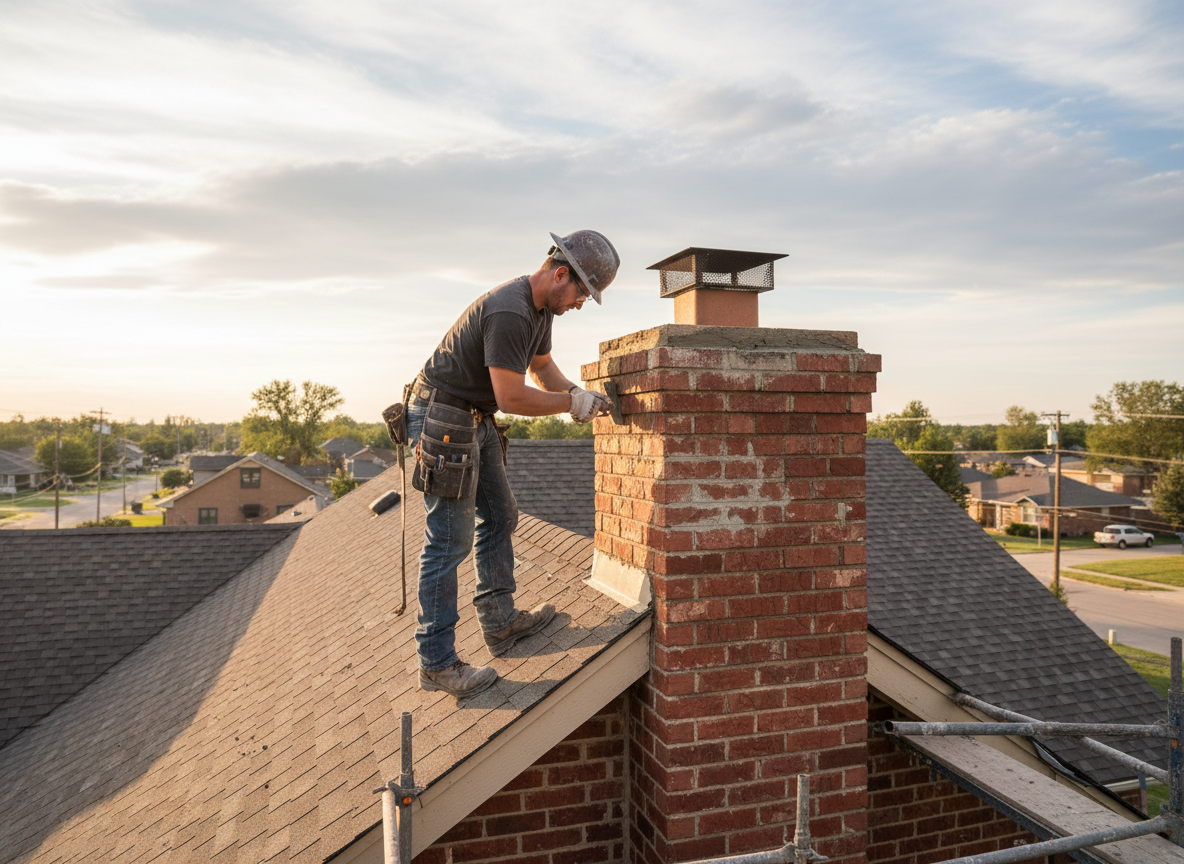
Riverton sits in Salt Lake County where semi-arid conditions bring hot summers followed by cold winters that drive repeated freeze-thaw cycles through brick chimneys. Older homes in neighborhoods such as Riverton Meadows and Western Springs often have lime-based mortar that has eroded over decades, allowing water to enter joints and push bricks loose during winter freezes. Tuckpointing requires matching the original mortar composition and tooling profile so the repair does not trap moisture or create new cracking points along the chimney stack.
Work on chimneys near Riverton City Park or the Old Dome Meeting Hall frequently involves two-story homes with limited roof access and narrow side yards that restrict scaffolding placement. Technicians must remove failed mortar to a consistent depth without damaging surrounding brick, then pack fresh mortar in layers that cure properly before the next temperature swing. Skipping proper depth or using modern Portland cement on historic lime mortar leads to faster failure when summer heat expands and winter ice contracts the joints.
Proper tuckpointing also accounts for wind-driven rain from the west and the occasional heavy spring runoff that saturates chimney bases in lower-lying sections of Harvest Park. After repointing, the mortar must be kept damp for several days so it does not dry too quickly in the high-desert air. Homeowners who attempt DIY repairs with pre-mixed caulk or mismatched color usually see the new material crack within one season, requiring full removal and redo.
Technician insight
In Riverton, the thing that catches most people out with chimney tuckpointing is the rapid freeze-thaw cycle that hits older brick homes in Riverton Meadows after a warm day drops below freezing at night. Homeowners often try to patch only the visible spots from the ground, missing the full depth needed on the north face where wind-driven moisture collects.
Two-Story Chimney in Western Springs
Loose mortar on the north side allowed water to enter during spring storms. Inspection showed joints eroded two inches deep on the upper third. Crew removed the old mortar, packed new lime mix in stages, and kept the work damp through a week of hot afternoons. The chimney now sheds water without further spalling after the first winter freeze.
How it works
- 1
Site Inspection
Examine chimney height, brick condition, and joint erosion from ground and roof level in the specific neighborhood.
- 2
Mortar Removal
Cut out damaged mortar to uniform depth while protecting surrounding brick on homes common in Riverton Meadows.
- 3
Mortar Mixing and Application
Prepare lime-based mix matched to original color and texture, then pack joints in layers suited to local temperature swings.
- 4
Tooling and Curing
Tool joints to match existing profile and keep mortar damp during the initial cure period in semi-arid conditions.
Pricing
Cost depends on chimney height, extent of joint failure, and access constraints typical in Western Springs and Harvest Park homes.